Summary
This is Part 6 of 6 — the final chapter of the series Complete History of AI: From Turing's Machines to Generative Models. The five previous chapters documented eight decades of history from consolidated sources. This chapter is different: it is written in July 2026, about the immediate present, with data that 2025 documents could not have. Its focus is strictly what happened — in models, in the labor market, in real adoption, and in regulation — without speculation about what will come. For what lies ahead, PrezencIA has specific pointys.
Context
The original document of this series was written at the end of 2025. At that time, what are today documented facts were still open questions or emerging trends. In six months, the field produced sufficient data to transform hypotheses into evidence. Three areas deserve specific documentation before closing this series: the state of models in July 2026, real labor market impact with verified data, and regulatory advances that transformed AI from a technical subject into a front-line public policy issue.
— The State of Models in July 2026
The first half of 2026 recorded the highest volume of frontier model releases in the field's history in a single semester: GPT-5.4 (March), Claude Opus 4.7 (April), GPT-5.5 Spud (April 23), DeepSeek V4 Preview (April 24 — less than 24 hours after GPT-5.5), Qwen 3, Llama 4, and Gemini 3.1 in the same six-week window, Claude Opus 4.8 and Claude Sonnet 5 in June, GPT-5.6 on June 23, and Grok 4.5 in July. The Stanford HAI AI Index 2026, published in April, documented the most significant technical data point of the period: the SWE-bench Verified benchmark — measuring AI models' ability to resolve real issues from GitHub repositories — went from 60% to near 100% performance in a single year. For context: in 2023, the best performance was below 5%. The speed of improvement in autonomous coding was the fastest ever recorded on any AI benchmark in comparable time. Two structural events marked H1 2026 beyond model releases. The first: on June 12, 2026, the US Commerce Department ordered Anthropic to disable Claude Fable 5 and Claude Mythos 5 — the first time in history that export controls were used to shut down deployed AI models rather than physical hardware. Frontier AI became treated as a national security strategic asset. The second: DeepSeek V4, released in April, was trained on Huawei Ascend chips rather than Nvidia GPUs — definitively validating that the Chinese semiconductor stack can train frontier models, eliminating the premise that chip export controls would prevent AI development in China. ARC-AGI-3 — a benchmark created specifically to resist LLMs — maintained its resistance: the best documented performance in July 2026 is 7.8%, far from any threshold of general adaptive reasoning.
— The Labor Market: What 2026 Data Confirms
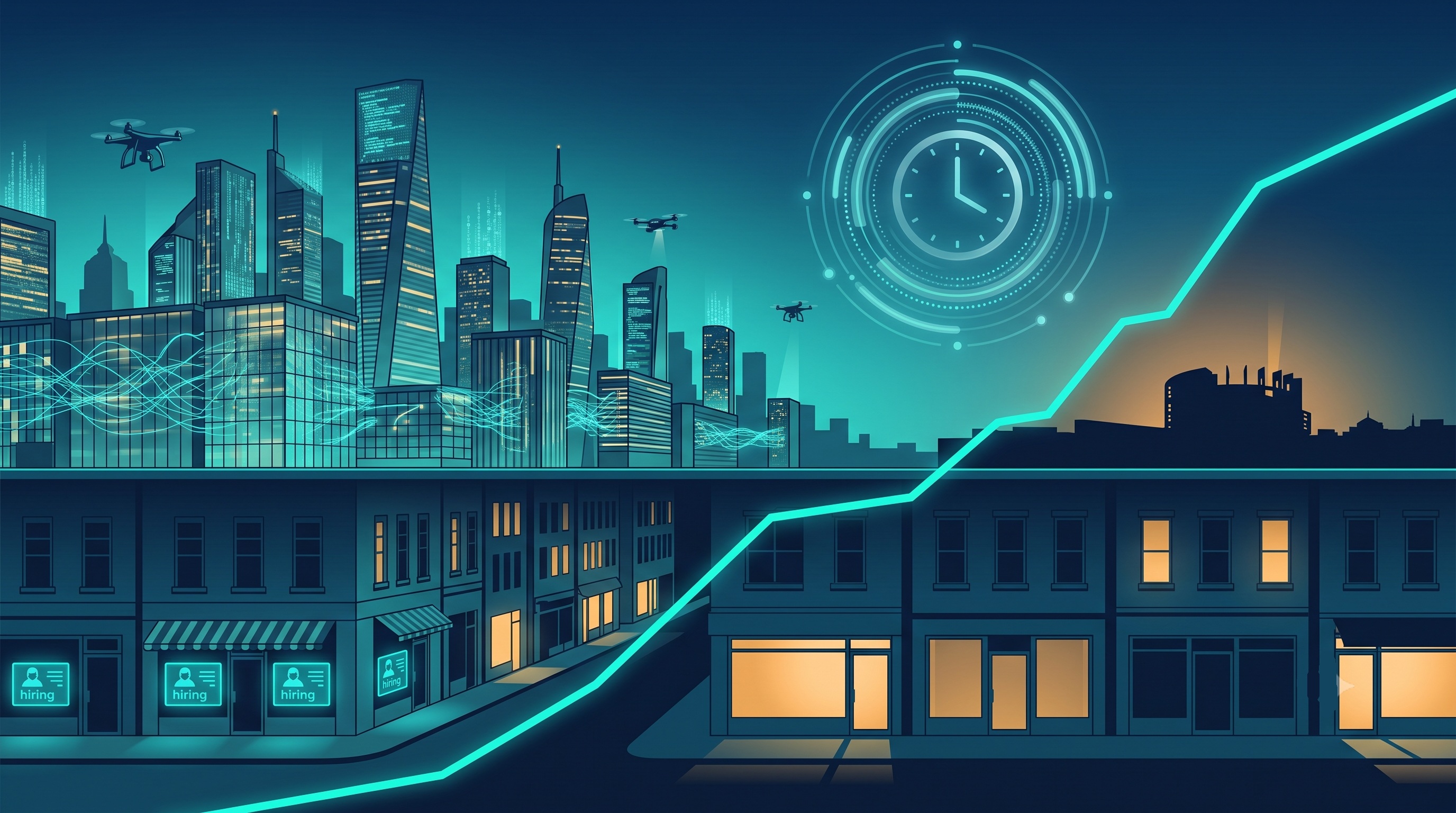
The Stanford HAI AI Index 2026, with econometric data verified by crossing ADP payroll records against AI adoption patterns, documented the most precise impact available through July 2026. The most cited data point: employment of software developers between 22 and 25 years old fell nearly 20% since 2024. At the same time, employment of developers over 30 continued growing — and employment for workers over 30 in highly AI-oriented functions grew from 6% to 12% in the same period. The pattern is not replacement of developers by AI. It is elimination of the entry step of the career: major tech companies cut junior-level hiring by more than 50% in three years. Goldman Sachs documented in an April 2026 report that AI is eliminating approximately 16,000 net jobs per month in the US — the result of 25,000 destroyed by AI substitution and 9,000 created by augmentation. In Q1 2026, 78,557 tech sector layoffs were recorded, with nearly half explicitly attributed to AI by the companies themselves. Workday cut 8.5% of its workforce (about 1,750 jobs) to redirect resources to AI investments. Amazon eliminated 14,000 corporate positions citing that AI enables leaner structures. JPMorgan Chase confirmed in February 2026 that it had displaced workers due to AI. McKinsey Global Institute documented in November 2025 that 57% of American work hours are technically automatable with current technology — 44% through AI agents and 13% through robots. The WEF Future of Jobs Report 2025 projects 92 million jobs displaced and 170 million created globally by 2030 — a net positive balance of 78 million. But the 92 million displaced are concentrated in administrative and office work with limited reskilling options; the 170 million created are concentrated in technical functions requiring advanced training. Workers with AI skills receive a 56% salary premium relative to peers without those skills in identical roles. AI-related job postings grew 3.5 times between 2023 and 2025. Generative AI adoption in business functions reached 70% of organizations globally in 2026, but autonomous agent deployment remains in single digits across virtually all business functions. Only 28.3% of American organizations reported using AI — placing the US 24th globally in adoption, behind Singapore (61%) and UAE (64%).
— Regulation: From Text to Implementation
The European AI Act — formally approved in 2024 — begins its most significant implementation phase on August 2, 2026, with the first absolute prohibitions entering into force: social scoring systems by public authorities, subliminal manipulation of human behavior, exploitation of vulnerabilities of specific groups, and real-time biometric identification in public spaces for law enforcement purposes, with limited exceptions. Systems classified as "high risk" — including AI in critical infrastructure, education, employment, essential services, law enforcement, and migration — now require compliance assessments, transparency records, and documented human oversight. The AI Act establishes fines of up to 35 million euros or 7% of global revenue for violations of the most serious prohibitions. It is the first comprehensive AI regulatory framework with legal force in any jurisdiction in the world. In the US, the approach remained fragmented in July 2026: no comprehensive federal legislation, with varied sectoral regulation by agency and emerging state legislation. Public trust in the American government to regulate AI was the lowest of any country surveyed by Stanford HAI — 31%. Only 10% of Americans stated in a Pew Research survey from March 2026 that they were more excited than concerned about AI. In Brazil, the CNJ had published Resolution 615 in 2025, establishing guidelines for AI use in the Judiciary — one of the most advanced sectoral regulatory frameworks in Latin America.
Comparative Analysis
The tension that closes this six-chapter series is the same that opens it: the distance between technical capacity and institutional capacity. In 1956, the Dartmouth Conference promised general intelligence within a generation — scientific and funding institutions had no way to evaluate that promise. In 2026, SWE-bench goes from 60% to 100% in one year — professional training institutions, labor regulation, and public policy cannot adapt at that speed. The pattern persists across seven decades: technology advances faster than collective human capacity to process and govern the change.
Analysis
Three observations that 2026 data allows with evidence, not speculation. First: labor market impact is real, documented, and asymmetric — it disproportionately affects entry-level workers and repetitive administrative functions, while senior and advanced technical functions benefit or are protected. Second: real AI adoption in organizations is systematically slower than technical progress suggests — 70% of organizations using AI in some function does not mean 70% of processes transformed; autonomous agents in single digits across business functions is the most revealing data point. Third: AI geopolitics produced an outcome most 2023-2024 analyses had not predicted — China and the US are technically paired on frontier models, with leadership alternating multiple times since 2025, making any narrative of unilateral American dominance factually incorrect.
Synthesis
This series covered eight decades — from Bletchley Park in 1942 to July 2026. The narrative arc is clear in retrospect: correct theoretical foundations that found inadequate infrastructure, two collapses that redistributed who remained in the field, silent accumulation of data and hardware, an explosion that nobody had predicted with precision, and an acceleration that rendered every prediction obsolete in months. What the history of AI from 1940 to 2026 teaches is not about AI — it is about the relationship between technology and human institutions. Every time the field advanced beyond what institutions could process, there was an adjustment: winters in the 1970s and 1980s, ethics debates in 2019, regulation in 2024, national security controls in 2026. The pattern suggests that the next adjustments will be proportional to the current speed of change — which is the fastest in the field's history. The history of AI is still being written. This portal exists to follow that process in real time, with depth, without hype and without filter.