Summary
This is Part 3 of 6 in the series Complete History of AI: From Turing's Machines to Generative Models. The period between 1993 and 2011 is the least celebrated in AI history — and possibly the most important. Without the hype of the 1980s or the explosion of the 2020s, this period produced the mathematical foundations, datasets, computational infrastructure, and algorithms that would make deep learning possible. It is the chapter nobody tells because it has no drama — only methodical and consequential progress.
Context
The second AI winter left the field with an unexpected legacy: researchers who survived both collapses were those who had learned to work without grand promises. The 1990s context was one of institutional skepticism about general AI, but growing interest in specific applications where performance metrics could be objectively verified. At the same time, three forces external to the AI field proper were quietly accumulating: the internet creating unprecedented data volumes, computing hardware getting exponentially cheaper following Moore's Law, and the machine learning community developing rigorous mathematical tools that replaced manual knowledge engineering. The result was a period of public silence and real productivity.
— 1993-2000: Mathematical Foundations and Cultural Milestones
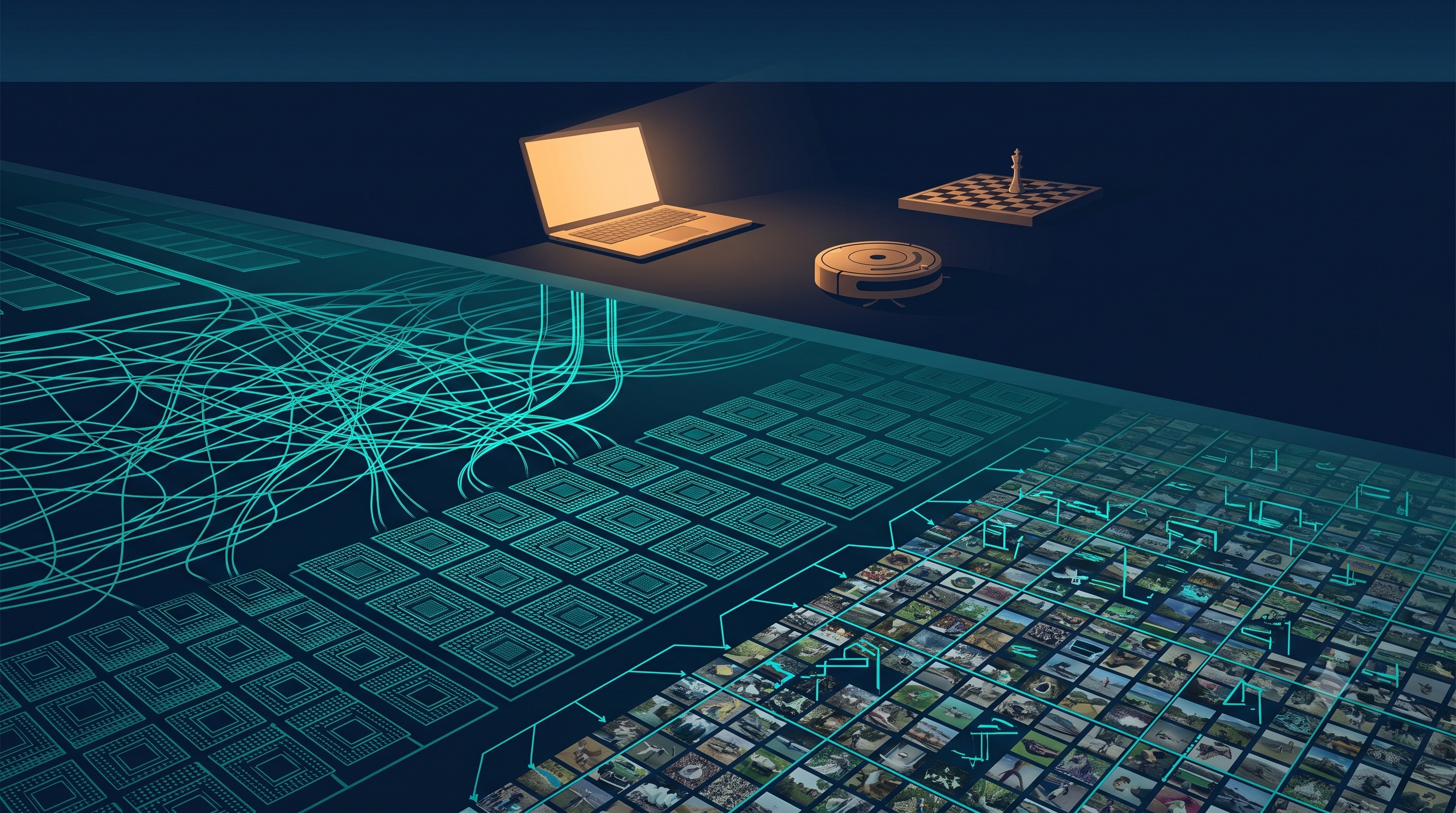
In 1995, Vladimir Vapnik and Corinna Cortes published Support Vector Machines (SVMs) — a classification algorithm with rigorous mathematical foundations that worked exceptionally well on practical problems with limited data. SVMs became the dominant machine learning algorithm for nearly a decade, applied in text recognition, medical image classification, and spam detection. They were mathematically elegant, interpretable, and did not depend on large data volumes — everything previous systems were not. In May 1997, IBM's Deep Blue supercomputer defeated world chess champion Garry Kasparov 3.5 to 2.5 in a six-game series — the first computational system to defeat a world chess champion under tournament conditions. The cultural impact was immense. Kasparov and others argued the machine had used "creative intelligence" in certain moves. AI researchers were more cautious: Deep Blue was a tree search system with specialized position evaluation, not a general-purpose system. But the cultural milestone established the narrative that machines could surpass humans in cognitive domains previously considered exclusively human. In 1998, Larry Page and Sergey Brin founded Google based on a seemingly simple idea: the relevance of a web page could be measured by the number and quality of other pages linking to it. PageRank was a machine learning algorithm disguised as a search engine. By indexing the web, Google inadvertently built the largest data corpus in human history — a corpus that would feed LLMs two decades later.
— 2000-2006: Invisible AI in Real Products
The 2000-2006 period was marked by the silent penetration of AI into consumer products and digital infrastructure without the public knowing it was interacting with artificial intelligence systems. In 2002, iRobot launched the Roomba — an autonomous vacuum robot that navigated home environments using sensors and simple planning algorithms. It sold over 10 million units by 2012, becoming the first consumer robotics product with mass market success. In 2003, Bayesian spam filters based on Paul Graham's algorithm became ubiquitous — every email user was, unknowingly, interacting with machine learning to filter unwanted messages. In 2006, Netflix launched the Netflix Prize — a $1 million competition to improve its recommendation algorithm by 10%. The competition ran for three years and produced significant advances in collaborative recommendation systems, while demonstrating that open data competitions could accelerate machine learning progress faster than traditional academic research. Meanwhile, Amazon developed recommendation systems that would eventually generate 35% of its revenues — invisible but economically determinative AI. During this period, Geoffrey Hinton had moved to the University of Toronto and continued his work on deep neural networks. In 2006, he published two crucial papers demonstrating that deep neural networks could be efficiently trained using a layer-by-layer unsupervised pre-training technique. Hinton coined the term "deep learning" to describe the training of networks with many hidden layers.
— 2007-2011: Seeds of the Explosion
In 2007, Fei-Fei Li, a Stanford professor, began building ImageNet — an annotated image dataset at unprecedented scale. The idea was simple and ambitious: if computer vision models needed data to learn, create the largest and most diverse image dataset ever assembled. Using Amazon Mechanical Turk workers to annotate millions of images across more than 20,000 categories, Li and her team built the dataset that would change the field. In 2009, the ImageNet Large Scale Visual Recognition Challenge (ILSVRC) was launched as an annual competition — the benchmark that would reveal the power of deep learning in 2012. In 2008-2009, Andrew Ng and other researchers began using GPUs to dramatically accelerate neural network training. GPUs, originally developed for video game graphics rendering, were architecturally ideal for the massive matrix operations neural networks required — they could execute thousands of operations in parallel where CPUs executed hundreds. In 2011, IBM's Watson system competed on the quiz program Jeopardy! against the two greatest champions in the show's history — Ken Jennings and Brad Rutter. Watson won convincingly, demonstrating the ability to process ambiguous natural language, retrieve information from vast knowledge bases, and respond with superhuman speed and accuracy across extremely varied domains of human knowledge. Watson's Jeopardy victory represented for natural language processing what Deep Blue had represented for chess in 1997 — a cultural milestone that made AI visible to the general public.
Comparative Analysis
The defining tension of the 1993-2011 period is between public invisibility and technical consequence. None of the advances of this period generated headlines comparable to ChatGPT in 2022 or Deep Blue in 1997. SVMs were not comprehensible to laypeople. ImageNet was an academic competition. Deep network pre-training was niche research. But each of these advances was a necessary piece for what would come. In 2012, when Hinton and his students Alex Krizhevsky and Ilya Sutskever won the ILSVRC with AlexNet by a margin that shocked the entire field, it was not a miracle — it was the convergence of decades of work that had occurred away from the spotlight: ImageNet's dataset, GPUs available in consumer hardware, the 1986 backpropagation algorithm, and Hinton's decades refining deep network architectures.
Analysis
The 1993-2011 period establishes the most undervalued pattern in AI history: technological revolutions are preceded by long periods of infrastructure accumulation that do not appear revolutionary as they occur. The internet was not built to create the data corpus that would feed LLMs — it was built to connect computers. GPUs were not developed to train neural networks — they were developed for video games. ImageNet was not created to train AlexNet — it was created to evaluate computer vision in general. None of these three elements was planned as part of a deep learning strategy. All were appropriated by the field when circumstances allowed. In 2026, the analogous question is: what infrastructure being built today for other purposes will make possible the next AI revolution nobody is predicting?
Synthesis
The 1993-2011 period produced something rare in technology history: sustained progress without a corresponding hype cycle. There was no investment boom comparable to the expert systems of the 1980s, no crash comparable to the second winter. Just methodical accumulation of technical capacity, data, and infrastructure. The result was that when the explosion came — with AlexNet in 2012 — it came from a field that had spent two decades building the right foundations without announcing it was doing so. The lesson for evaluating the current moment is precise: the visible hype cycles of 2024-2026 probably obscure foundational work that will only be recognized as determinative years later. What is being built today in silence — in RAG, in causal reasoning, in world models, in efficient inference hardware — may be the equivalent of ImageNet and GPUs of this era: invisible now, determinative later. Next: Part 4 — The Deep Revolution (2012–2022)