Summary
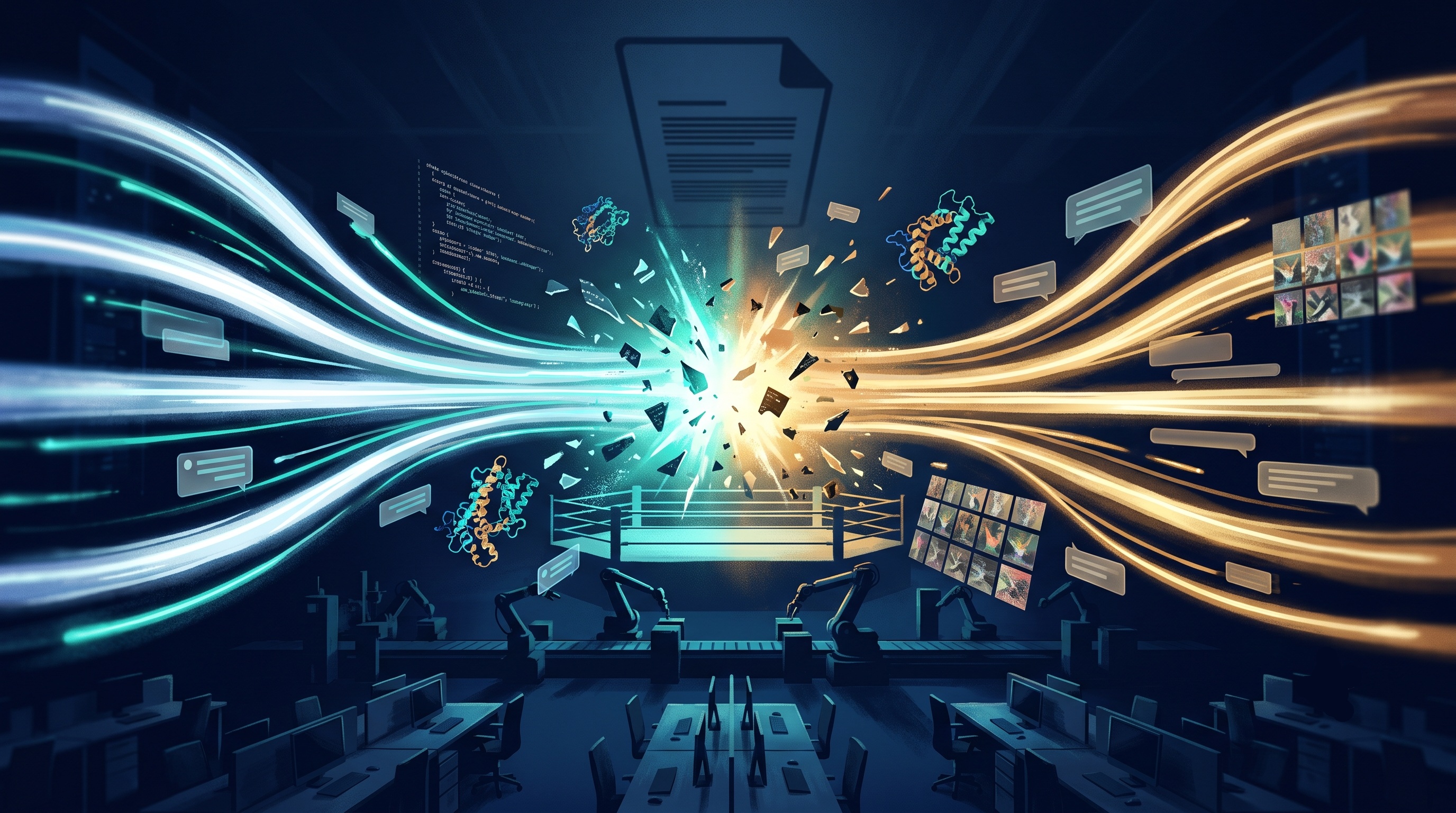
This is Part 5 of 6 in the series Complete History of AI: From Turing's Machines to Generative Models. The period between 2023 and 2025 is the closest to the present and the one that most rapidly became historical. In less than three years, AI moved from consumer app phenomenon to national security matter, from competition between American labs to global geopolitical race, and from productivity tool to infrastructure governing medical, legal, and financial decisions at scale. This chapter documents how acceleration became the norm.
Context
The context defining 2023-2025 is the unexpected success of ChatGPT in November 2022. No technology company had planned for the level of attention and demand ChatGPT generated. Google, which had developed the Transformer's fundamental technologies and had superior language models in the lab, was caught off guard by OpenAI's public demonstration. Microsoft, already an OpenAI investor, announced an additional $10 billion investment in January 2023 and integrated generative AI into Bing, Office 365, and Azure. The race that followed was the most intense in AI history: not just between companies, but between countries, paradigms, and philosophies about how AI should be developed and who should control its access.
— 2023: GPT-4, Proliferation and the Bard Moment
In March 2023, OpenAI released GPT-4 — a multimodal model capable of processing text and images, with a context window of up to 32,000 tokens. GPT-4 demonstrated near-human performance on professional benchmarks: 90th percentile on the US bar exam, 89th percentile on SAT Math, above 86% on multiple AP exams. Anthropic released Claude in March 2023, positioned as an assistant focused on AI safety and "Constitutional AI" — trained to be helpful, harmless, and honest following a set of constitutional principles. Google released Bard in February 2023 — and the launch was catastrophic. A demonstration contained a factual inaccuracy that was widely criticized, causing Google's stock to fall 8% in a single day, losing $100 billion in market value. The episode illustrated Google's vulnerability: it had invented the Transformer and had the best researchers, but had underestimated the impact of interface on public perception. Meta released the LLaMA family in February 2023 with a non-commercial license for researchers — model weights that were immediately leaked and became widely available. In July 2023, it released LLaMA 2 with an explicit commercial license in partnership with Microsoft, triggering a wave of open-source projects. In December 2023, Google DeepMind presented Gemini — a natively multimodal model designed from the ground up to process text, images, audio, video, and code.
— 2024: Reasoning, Agents and AlphaFold
In 2024, the field's focus shifted from larger models to more capable and specialized ones. OpenAI released the o1 series in September 2024 — models designed specifically for reasoning, spending more time "thinking" before responding, decomposing complex problems into steps, and verifying their own work. o1 demonstrated dramatic performance in competitive mathematics (89th percentile at the International Mathematical Olympiad) and coding (93rd percentile at Codeforces). Google DeepMind released AlphaFold 3 — capable of predicting structures not just of proteins but of complete biomolecular complexes including DNA, RNA, and small molecules. In 2020, AlphaFold 2 had solved the protein folding problem that had frustrated biologists for 50 years. In 2021, it had predicted structures for over 200 million proteins — practically all proteins known to science. AlphaFold 3 expanded that power to the level of complete molecular systems, dramatically accelerating drug development. Geoffrey Hinton and John Hopfield received the 2024 Nobel Prize in Physics for their fundamental contributions to the development of artificial neural networks — formal recognition that the field had moved from computer science to impact across all of science. Growing interest in autonomous agents — systems that could not just answer questions but execute actions in the digital world — generated frameworks like LangChain and AutoGPT, and startups like Cognition AI with Devin, presented as an "AI software engineer." In practice, 2024 agents demonstrated impressive capabilities in controlled conditions but consistently failed at unstructured real-world tasks.
— 2025: DeepSeek, Open Source and Regulation
On January 10, 2025, Chinese company DeepSeek released DeepSeek-R1 — a reasoning model that outperformed ChatGPT on multiple benchmarks at a training cost of just $5.3 million, versus estimates of hundreds of millions for equivalent American models. Within hours of the announcement, Nvidia lost approximately $600 billion in market value in a single trading session. The message was immediate: algorithmic efficiency could rival raw processing power, and American chip export restrictions to China had not prevented frontier AI development. The "DeepSeek moment" became a frequently repeated expression — the first time many people realized they could have top-tier performance without going through OpenAI, Anthropic, or Google. In response, Project Stargate emerged as a strategic alliance valued at $500 billion, bringing together OpenAI, SoftBank, Oracle, and the American government to build AI infrastructure in the US. The European Union approved the AI Act in 2024, with progressive implementation in 2025 — the world's first comprehensive AI legislation, establishing risk categories, transparency requirements, and prohibitions on high-risk uses like social scoring systems and mass biometric surveillance. In 2025, Meta released Llama 4 with technical parity relative to proprietary frontier models — for the first time, open models reached performance comparable to closed systems, with native multimodal capabilities and zero licensing cost. The democratization of advanced AI began to have profound implications: any organization with adequate hardware could run frontier-quality models without dependence on commercial APIs.
Comparative Analysis
The central tension of 2023-2025 is between simultaneous democratization and concentration. On one hand: Llama 4 and DeepSeek made frontier AI accessible to any organization with adequate hardware, open source flourished, and cost per token fell by orders of magnitude. On the other: the power to train truly frontier models concentrated in fewer than five labs in the world, each requiring investments of hundreds of millions to billions of dollars per training cycle. AI became simultaneously more accessible for use and more concentrated for development — an asymmetry that no regulation had adequately addressed by the end of 2025.
Analysis
Three patterns from 2023-2025 are determinative for understanding 2026. First: AI geopolitics surpassed enterprise competition as the structuring factor — DeepSeek was not just a better model, it was a demonstration that the American chip-control strategy had not worked as planned. Second: the bifurcation between open and closed models deepened without resolution — open source gained in access and democratization, closed source maintained an advantage in cutting-edge frontier models; the implications for security, intellectual property, and power concentration remain open. Third: the gap between benchmark performance and real utility remained the largest documented source of disappointment of the period — organizations expecting immediate transformation discovered that adoption is harder than technical capability.
Synthesis
The 2023-2025 period ended any doubt about whether generative AI was a passing phenomenon. In two years, it moved from consumer app experiment to American national security matter, to the central theme of European regulation, to Chinese state strategy, and to infrastructure in production in hospitals, courts, banks, and offices worldwide. What was not resolved in 2025 — structural hallucinations, reliable autonomous agents, value alignment at scale, equitable distribution of benefits — are the questions that define the current moment. The history of AI between 1940 and 2025 is the history of a field that survived two winters, accumulated infrastructure in silence, and accelerated beyond human institutions' capacity to process the change. What comes next is the subject of Part 6. Next: Part 6 — Open Frontiers (2025–2026)