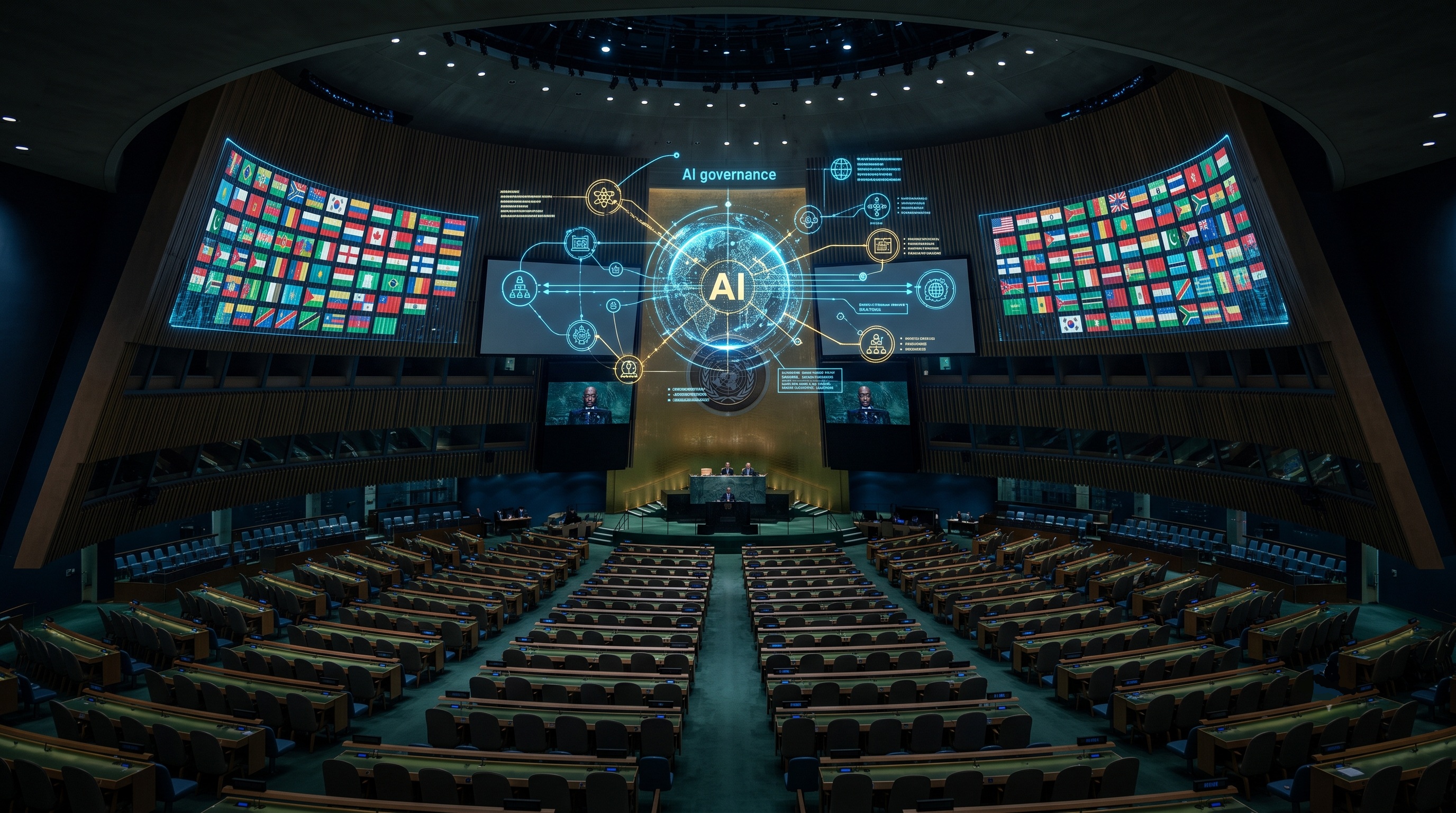
The Palexpo Convention Centre in Geneva became the center of global AI governance on July 6 and 7, 2026. For the first time in history, the UN convened all 193 member states for the Global Dialogue on AI Governance — the first AI forum established by a UN General Assembly resolution, rather than by an invitation from a host government.
Previous summits — Bletchley Park in 2023, Seoul in 2024, Paris in 2025, New Delhi in 2026 — were convened by individual governments and attended by invitation, typically limited to technologically advanced nations. Geneva changed that logic: all 193 countries were guaranteed a seat.
What the scientific panel said
Five days before the forum, the Independent International Scientific Panel on AI — composed of 40 experts from multiple disciplines and continents — delivered its inaugural report with a conclusion that was placed on official record: science currently cannot guarantee that increasingly capable AI systems will not cause catastrophic harm.
It is the first time the international community has officially placed this admission of uncertainty on the formal record.
The structural problem that the forum revealed
191 of the 193 countries present at the Geneva table do not have independent computational capacity to audit, evaluate, or test the AI systems they are being called upon to govern. Any safety standard agreed upon in Geneva will depend, for its technical enforcement, on the very same big techs that the forum is trying to regulate.
The Dialogue is explicitly non-binding — it produces a co-chair summary, not enforceable rules. Its significance lies in establishing a universal and recurring forum. The second session is already scheduled for New York in May 2027.
The parallel regulatory context
The dialogue in Geneva took place at the same time that the EU AI Omnibus — a simplification amendment to the AI Act approved in a political agreement on May 7, 2026, and in effect since July 27, 2026 — came into force. The AI Act's transparency rules take effect in August 2026. Rules for high-risk systems (biometrics, critical infrastructure, education, employment) will only apply starting December 2, 2027.
The divide is clear: the EU has binding rules. The UN has a forum. The distance between the two defines the challenge of global AI governance in 2026.