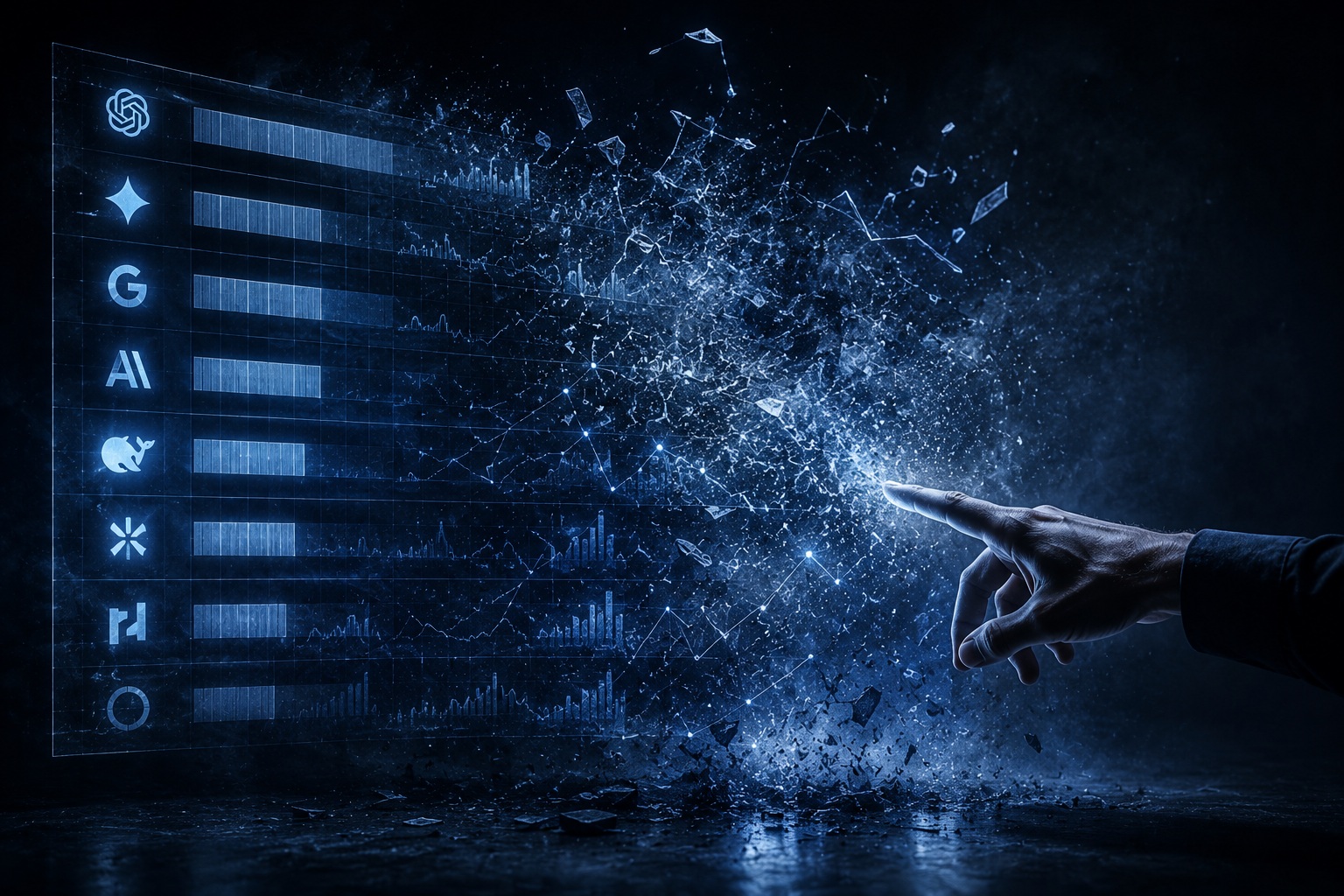
GPT-5, Claude Opus 4.6, Gemini 3.1 Pro, Grok 4, and DeepSeek V3.2 currently occupy the frontier range, with Arena Elo scores between 1,450 and 1,561. The problem is that this list changes every week — and understanding why requires understanding the collapse of traditional benchmarks.
The era of saturation
Many of the benchmarks from the GPT-3 era are now completely saturated — top models routinely score 95% or higher on MMLU, HumanEval, and HellaSwag, rendering them useless for distinguishing frontier capability.
Translating: asking MMLU which is the best model in 2026 is like using a 30cm ruler to measure the difference between two skyscrapers. The tool does not have enough resolution for the problem.
The gold standard that emerged
The Chatbot Arena — formerly LMSYS, now also called LMArena and Arena AI — now has over 6 million votes and 37 months of history. Humans compare two anonymous responses side-by-side and vote for the preferred one. The frontier range in 2026 is between 1,450 and 1,560 Arena points.
It is the only benchmark that measures what matters to the end user: which model you prefer to converse with. But it has a documented structural problem: users tend to prefer longer, more confident responses with markdown — which can inflate verbose models regardless of the real quality of reasoning.
The benchmarks that still matter in 2026
The benchmarks that matter in 2026 share three properties: contamination resistance, verifiability, and long-horizon evaluation. LiveBench rotates questions monthly from newly published research. SWE-bench runs the PR against the repository's real test suite. Aider Polyglot scores against Exercism's unit tests.
In practice, the five benchmarks that really differentiate frontier models in 2026 are: GPQA Diamond for graduate-level science, SWE-bench Verified for real code, Aider Polyglot for multilingual programming, BFCL for function calling, and the Chatbot Arena Elo for human preference.
The data that redefines the race
Meta AI, DeepSeek, and Mistral AI collectively boosted the quality of open-weights models faster in the last 12 months than in any comparable period in LLM history, and the trajectory suggests that the remaining gaps will narrow even further by the end of 2026.
This changes the competitive equation: the difference between the best proprietary model and the best open-weights has never been so small. And when the quality gap narrows, the cost per token and data privacy become the decisive criteria.
What the executive needs to understand
An MMLU score says nothing in 2026. What does: performance on GPQA Diamond for complex reasoning tasks, SWE-bench for software development, and Arena Elo for general conversational use. And for any real purchasing decision, no benchmark replaces testing with your operation's specific data and tasks.