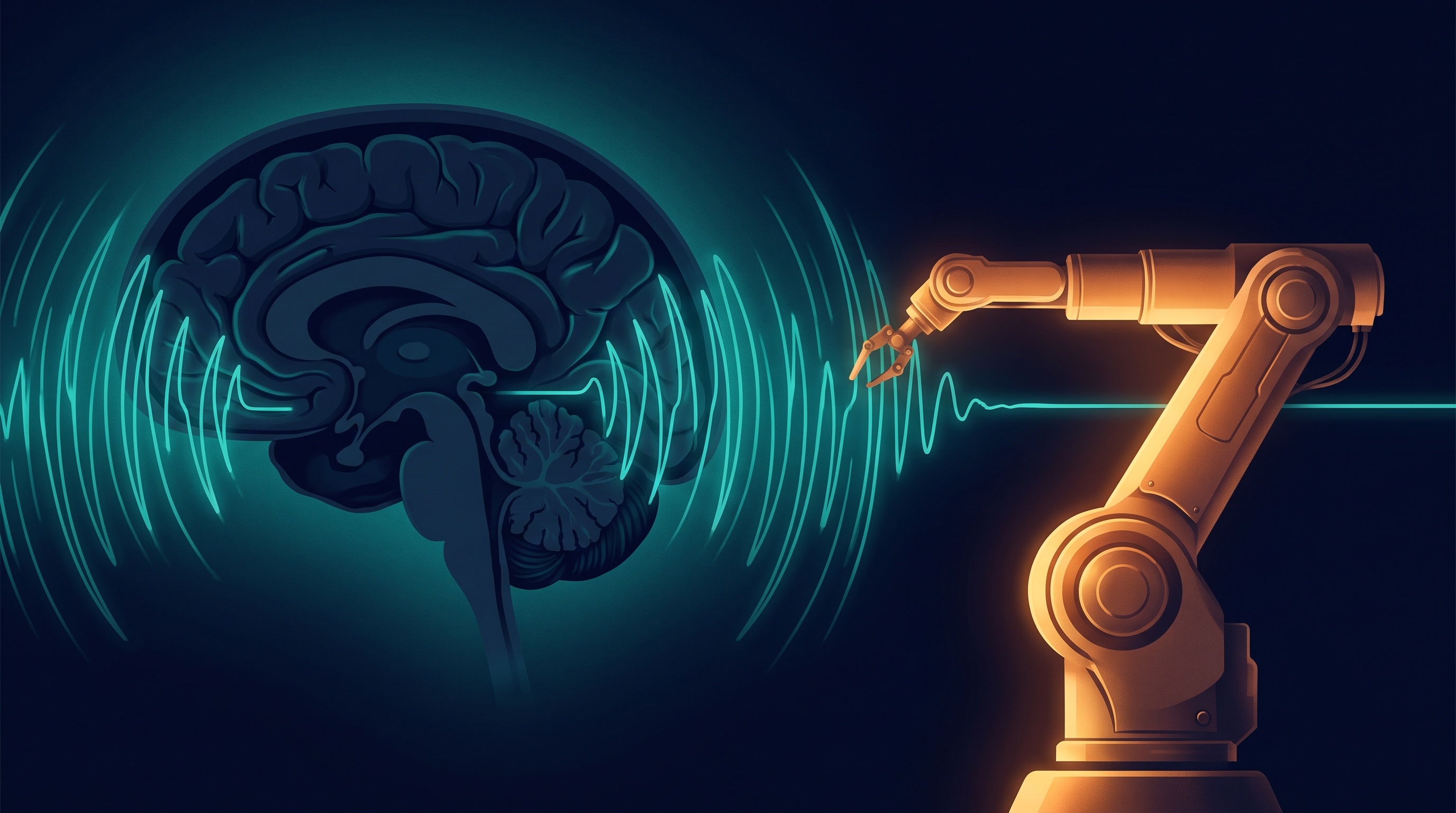
On July 17, 2026, at the World Artificial Intelligence Conference (WAIC) in Shanghai, BrainCo demonstrated live something that stopped traffic in the pavilion: a human wearing a lightweight EEG headset, thinking about picking up a cup, and a robotic arm doing exactly that. No button, no voice, no physical movement.
The Current State of BCIs in 2026
BrainCo's demonstration at the WAIC was not a laboratory prototype. It was the public presentation of an architecture the company calls "Neuro-Embodied-AI": BCIs decode intent, an AI layer refines that intent into actionable steps, and the robot's physical systems execute. It is the integration of three fields that were separated for decades — neurotechnology, AI, and robotics — into a single pipeline.
At the same time, Neuralink has been operating in human patients for over 18 months. Noland Arbaugh, the first human to receive a Neuralink implant in January 2024, had accumulated thousands of hours of continuous use by early 2026. Synchron obtained FDA approval. The global BCI market is valued between US$ 8–12 billion.
The Problem BCIs Solve for Physical AI
One of the biggest bottlenecks in modern robotics is the scarcity of high-quality training data. BrainCo presented a direct solution at the WAIC: the neural interface captures human intention in real-time during task execution, creating demonstration data with thought resolution, not just movement. This connects directly with the problem that LeCun, Fei-Fei Li, and the field of world models are trying to solve.
Neuralink and Sam Altman's Race
In parallel with Elon Musk's Neuralink, Sam Altman launched Merge Labs — focused on BCIs as a cognitive extension for AI. In March 2026, the Journal of Neural Engineering published Neuralink data showing implantation time reduced from 90 to under 30 minutes and a 5 dB improvement in the neural signal SNR.
What Does Not Exist Yet
Mainstream consumer BCIs are still years away. The issues of mental privacy — who accesses neural data, for what purpose, under what regulation — have no legal answer in any jurisdiction. What exists in 2026 is the most convincing proof of concept yet that the trajectory is real.