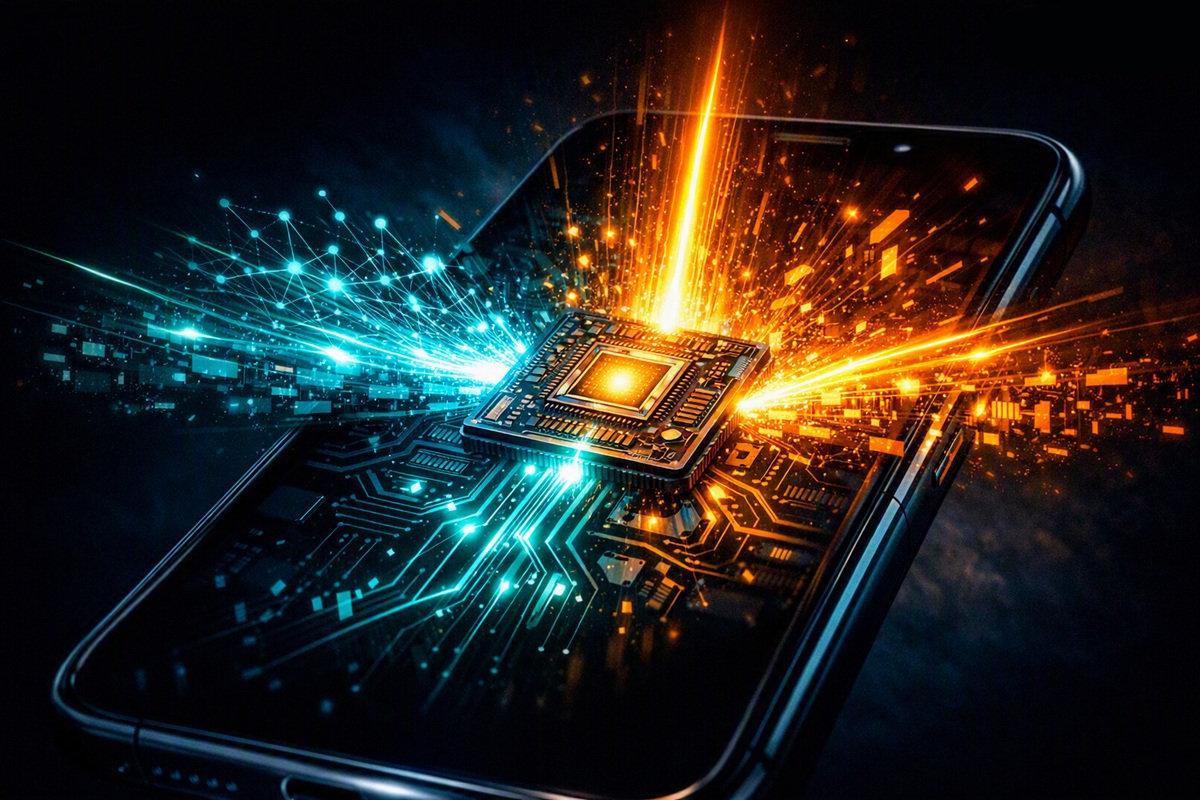
In August 2026, the new generation of mobile chips — Apple A20 Bionic and Qualcomm Snapdragon 8 Gen 5 — include Neural Processing Units capable of running 70-billion parameter models completely on-device. No internet connection. No data sent to corporate servers.
What in 2024 required an entire data center now fits on the chip in your pocket.
What changed technically
The evolution of NPUs in the last two years was exponential. The A20 Bionic and Snapdragon 8 Gen 5 execute 70B models in local inference with latency comparable to cloud API responses — and without the cost per token that makes massive use of frontier models in production impractical.
For reference: 7B models in 2026 already surpassed the performance of 2025's 70B models. Quality compression per parameter accelerated alongside hardware capability.
Why this changes the privacy debate
The most profound implication is not technical — it is architectural. When the model runs on the device, the data never leaves the handset. Photos, voice notes, personal emails processed by AI without passing through any external server.
This creates a new category of AI personal assistant: deeply personalized, with persistent local memory, without the privacy risks associated with cloud models. The user can have an AI that knows everything about their life with absolute assurance that this data is not going to corporate servers.
The impact for the enterprise market
For companies, the implication is even more direct: confidential data processed locally eliminates the main regulatory obstacle for AI adoption in sectors like healthcare, finance, and law. LGPD and GDPR become easier to comply with when data never leaves the device.
The debate on data sovereignty — which led NAVER and NVIDIA to build a $10 billion AI factory in Korea — finds its most elegant answer on the smartphone chip: total sovereignty, zero infrastructure cost, minimal latency.
What comes next
The trajectory is clear: if 70B runs in your pocket in 2026, 2024's frontier models run on your watch in 2028. The race is no longer just between labs — it is between chip makers. And Apple and Qualcomm just entered the AI race irrevocably.