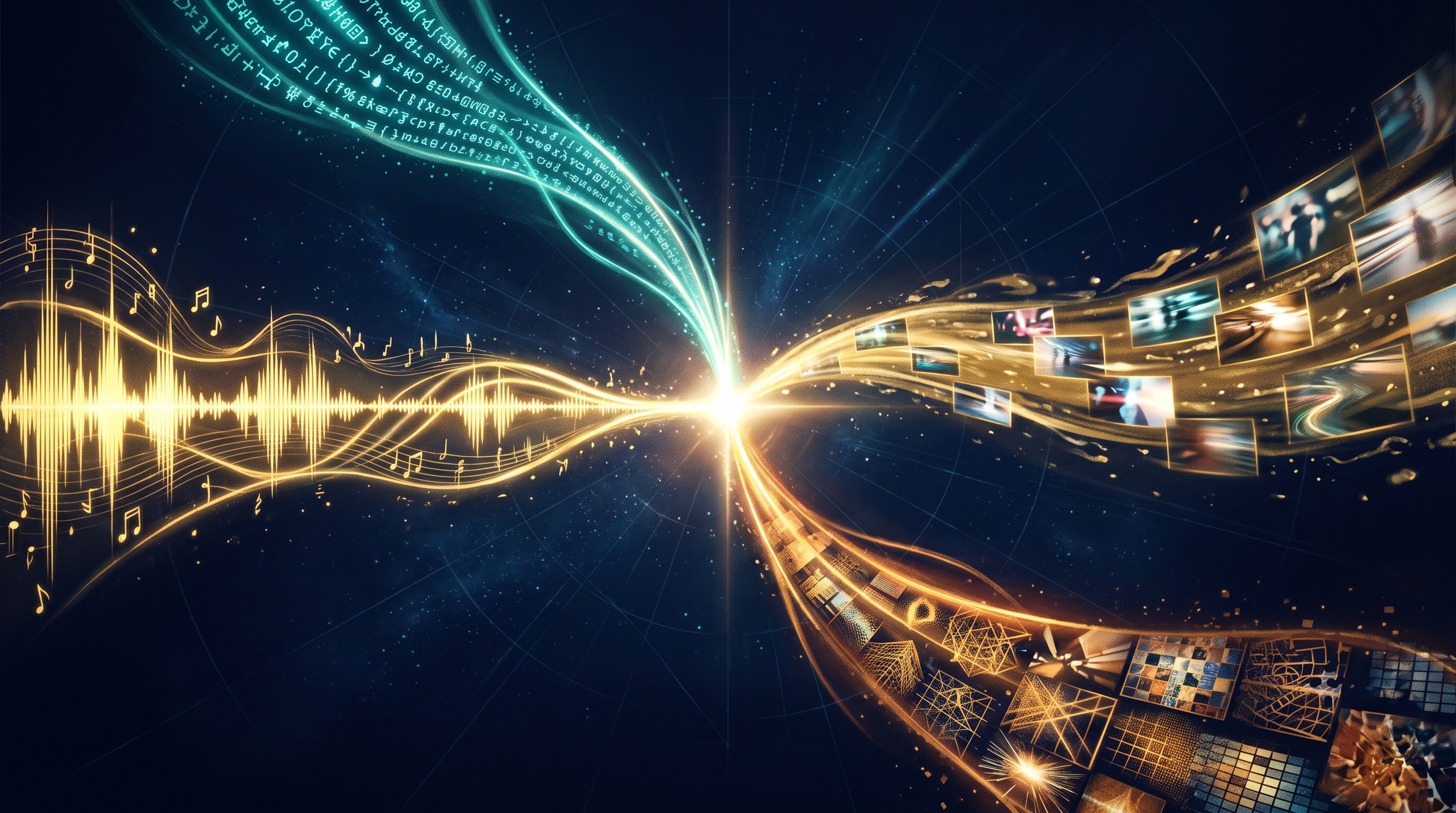
In 2021, AI models were fundamentally single-track: GPT-2 read text, DALL-E generated images, Whisper transcribed audio. You could not ask any of them to reason about a chart while simultaneously listening to an audio description of it. By 2026, this fragmentation is gone — and multimodal AI has crossed from "impressive demo" to "production infrastructure."
The distinction defining the field in 2026 is not "has vision or does not." It is the difference between natively multimodal and bolted-on multimodal.
Native vs. Bolted-on: Why Architecture Matters
Native multimodal models — GPT-4o, Gemini 3.1 Pro, Meta Muse Spark — were trained from the ground up to process text, image, audio, and video as a unified system. Bolted-on models had vision or audio added later, via a separate pipeline.
The difference in tasks requiring cross-modal reasoning is substantial. A native model can take in a chart, an audio description of the context, and a text question — and reason across all three simultaneously. A bolted-on model processes each modality separately and concatenates the results. For simple tasks, the difference is small. For complex tasks — analyzing a video presentation and answering questions about trends shown in graphs — the difference is massive.
The Performance Map in 2026
The April 2026 benchmarks reveal a clear fragmentation of leadership by domain:
Video: Gemini 3 leads with 78.4% on the long-form Video-MME — 7 points above the runner-up GPT-5.5 (71.2%). The advantage widens to 12 points in multi-clip reasoning and temporal understanding. For any video-intensive workload in 2026, Gemini 3 is the standard.
Code with Vision: GPT-5.5 leads DocVQA-Code and SWE-Bench-Vision — tasks where the model must reason over code shown as a screenshot, IDE window, or terminal output. The ability to visually inspect code and propose fixes is GPT-5.5's defining edge.
Long Documents and OCR: Claude Opus 4.8 leads in long-document reasoning and careful visual review. For PDFs, screenshots, invoices, forms, and reports where layout matters, Claude is the precision choice.
Multilingual: Qwen 3.5 Omni has the broadest coverage — 40+ languages with native ASR. Gemini 3 covers 30+. GPT-5.5 is strong in English, Chinese, Spanish, and Japanese, but weaker in long-tail languages.
Audio: The Modality That Changed Roles
The integration of native audio changes what is possible in ways that transcend transcription. In native models, prosody — the pattern of intonation, rhythm, and emphasis in speech — is preserved in audio tokens, and the model can use it to infer emotion, urgency, or sarcasm. In text-transcription-based systems, this information is destroyed before it ever reaches the model.
GPT-4o Voice and Google Gemini Live are the leading native voice products in mid-2026. For pure transcription without reasoning, specialized models like Whisper-3 (OpenAI) and Parakeet (NVIDIA) still lead in accuracy. The rule of thumb: use pure ASR for simple transcription; use multimodal for transcription-plus-action.
What Has Not Arrived Yet
Long-form video remains the toughest challenge. Gemini 3.5 Flash has a context window of 1 million tokens and processes full-length videos — but even with this capacity, reasoning over complex narratives in multi-hour videos yields inconsistent results. The "spatial intelligence" that Fei-Fei Li aims for with World Labs — a genuine understanding of three-dimensional relationships — has yet to reach production models. And AI-generated audio, despite significant advancements, still lacks the emotional expressivity and prosodic variation that characterize natural human speech.